EN
EN  FR
FR  DE
DE  RU
RU  JA
JA  AR
AR  ES
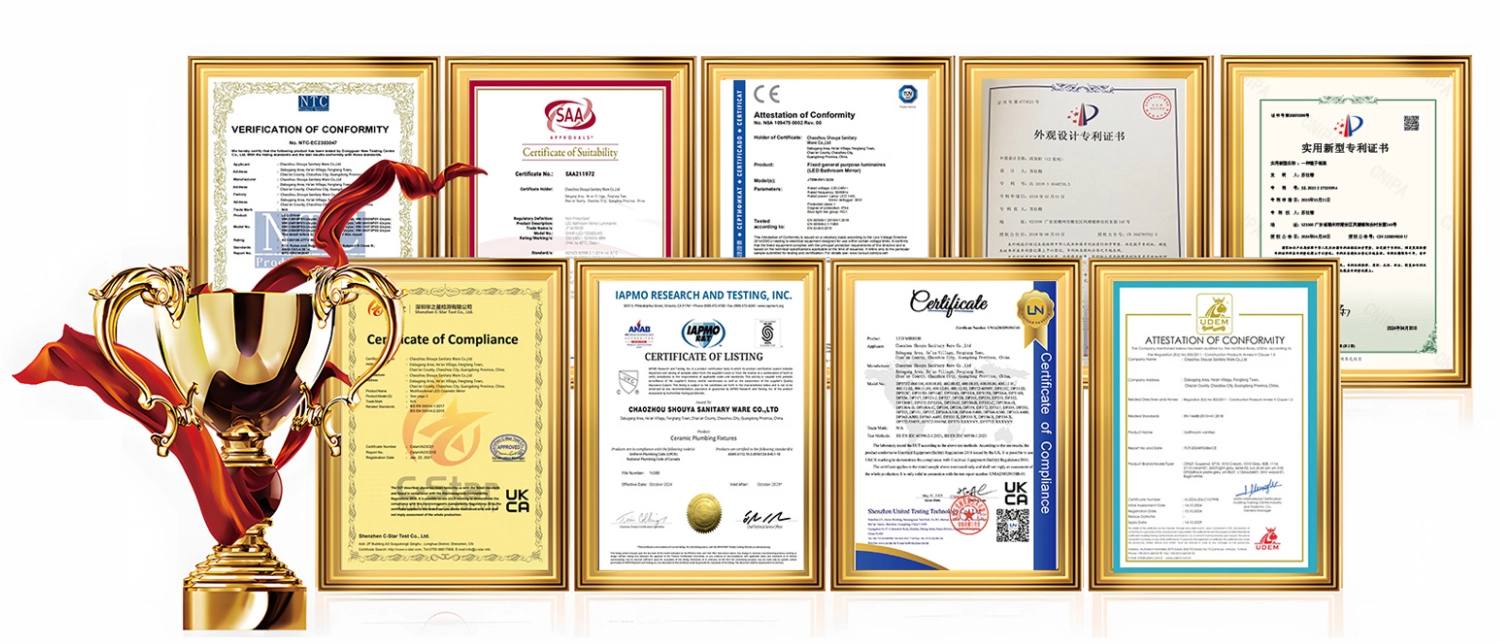
ES International certification is not a cost, but the golden key to open overseas markets.
Shipments are detained at the destination port due to incomplete certifications, resulting in heavy losses. Customers repeatedly ask about certification qualifications, but are unable to provide a systematic answer. Missing out on a major order due to substandard certification, only to have your competitors take it. Many bathroom exporters have experienced the above pain points. As a leading bathroom cabinets manufacturer, Shouya will help you understand the bathroom export certification for bathroom products in major global markets, allowing you and your customers to easily overcome technical barriers and capture the international market!
EU market: CE certification is the “entry ticket”
The EU implements mandatory CE certification for bathroom products, which must comply with the Construction Products Regulation (CPR) and sub-standards:
Core Certification:

Key Products and Standards:
- Toilets/Water Closets: EN 997:2018 (tests nine key criteria, including water seal depth, flushing function, and splash resistance);
- Faucets/Showers: EN 817 (mechanical properties), EN 14428 (flow rate and scalding protection);
- Bathtubs/Shower Enclosures: EN 14516 (household bathtubs), EN 14527 (shower trays).
Additional Requirements for Electrically Conductive Products: For example, bathroom heaters must meet the following requirements:
- Low Voltage Directive (LVD): Electrical Safety (EN 60335-2-30);
- Electromagnetic Compatibility Directive (EMC): Interference Immunity (EN 55014).

Certification points:
- Technical documentation must include a risk analysis report and installation instructions.
- The product must be permanently affixed with a CE mark ≥ 5mm thick.
- Note: After Brexit, UKCA certification will be required. The standards are similar to CE, but a separate submission is required.
North American market: dual-track certification network
The United States and Canada each have their systems, but the mutual recognition of certification is relatively high:
US market

CUPC Certification:
Issuing Organization: IAPMO (International Association of Plumbing Engineers);
Applicable Products: Plumbing fittings, valves, and toilet tank accessories;
Core Requirements: Compliance with the UPC Uniform Plumbing Code, requiring annual inspection and factory audit.
Material Safety Certification:
- NSF/ANSI 61: Lead Content and Leaching Testing for Drinking Water Contact Parts (Faucets, Hoses);
- AB1953: California’s Mandatory Low Lead Requirement (weighted average lead content ≤ 0.25%).
Energy Efficiency and Water Conservation Certification:
- DOE Certification: Federally mandated, covering flow limits for showerheads and faucets (e.g., showerheads ≤ 9.5 L/min);
- CEC Certification: California-exclusive, stricter than DOE (e.g., basin faucets ≤ 5.7 L/min);
- WaterSense Label: EPA-issued water conservation seal, enhancing consumer trust.
Canadian market
CSA certification: equivalent to the US CUPC, covers bathroom hardware and pipes, and accepts “one test, two countries acceptance”.
Australia and New Zealand: WaterMark + WELS dual insurance
WaterMark certification:
Mandatory: All water-related products must pass this test; failure to do so may result in a fine of up to AUD 100,000.
Level of Management:
- Level 1: High-risk products (e.g., drinking water pipes and faucets) require laboratory testing and annual factory inspections.
- Level 2: Low-risk products (e.g., bathtub brackets) require only a document review.
Testing Focus: Water pressure tightness and material corrosion resistance (AS/NZS 3500 series of standards).

WELS water efficiency label:
Mandatory labeling of water consumption levels (similar to energy efficiency labels) on products like toilets and showerheads will influence buyers’ decisions.
Reminder: Jacuzzi bathtubs must also meet the WMTS525:2018 standard, with a testing period of up to three months.
Suggestions for Factories and Buyers From Shouya
For Factories:
- Allow for certification cycles during the design phase (e.g., WaterMark Level 1 requires 8–12 weeks);
- Establish a raw material traceability system to prevent certification lapses due to supplier changes.
- Modular production: Using the same product line reduces retesting costs.
For Buyers:
- Require suppliers to provide certificate numbers and verify authenticity on their official website (e.g., WaterMark certificates can be checked on the ABC website);
- Pay attention to water-efficiency labels (e.g., WELS and WaterSense); high-rated products are more likely to receive government orders.
- Be wary of “low-priced, uncertified goods”; customs clearance risks can lead to supply chain disruptions!
Conclusion
Competition in the bathroom industry is essentially a battle for control over standards. Mastering certification rules early means securing customer trust and gaining market dominance. The global market is open. Do your products possess these necessary qualifications? Shouya, a professional bathroom cabinet manufacturer with international certifications, helps you easily overcome certification thresholds, quickly enter overseas markets, and win more orders. Contact us to get professional export certification support!